Subterranean termites, primarily Reticulitermes flavipes , are pervasive native soil insects in Middle Tennessee that require constant moisture to survive. Across Nashville, older crawlspace foundations in East…
Subterranean termites, primarily Reticulitermes flavipes, are pervasive native soil insects in Middle Tennessee that require constant moisture to survive. Across Nashville, older crawlspace foundations in East Nashville, Sylvan Park, and Belmont-Hillsboro frequently display shelter mud tubes ascending poured concrete piers or hollow cinder block stems. In newer slab constructions throughout The Nations and Germantown, subterranean foragers gain entrance through hidden expansion joints, bath traps, and utility penetrations beneath floating floors. RavenStone Pest Guard approaches these intrusions not as superficial spraying events, but as precision barrier installations regulated under the EPA Federal Insecticide, Fungicide, and Rodenticide Act. Diagnostic mapping inspects sill plates, rim joists, and subfloors for localized hollowed wood without causing alarmist disruption. Remediation establishes uninterrupted chemical or physical boundaries between subsurface colony nests in Davidson County clay soils and structural timber.
Selecting between continuous non-repellent liquid soil applications and exterior perimeter bait stations depends on architectural design and site grading. Continuous liquid barrier treatments utilize active ingredients such as fipronil, applied at standard volume rates established by the structural entomology research standards of 4 gallons per 10 linear feet per foot of depth. The non-repellent formulation permits subterranean workers to traverse the treated substrate without detection, systematically transferring the active ingredient throughout the reproductive colony via trophallaxis. For homes situated near aquatic reserves or karst geology, such as parcels abutting the Shelby Bottoms Greenway or slopes surrounding Radnor Lake State Park, an exterior bait matrix provides an eco-engineered alternative. Station networks employ insect growth regulators like noviflumuron, intercepting foraging workers through exterior ground stations spaced every 10 to 15 linear feet around the perimeter. The primary trade-off involves time and structural disruption: liquid barriers halt entry within days but require mechanical concrete drilling on attached patios, whereas bait systems require no slab drilling but necessitate systematic quarterly monitoring to confirm full subterranean colony collapse.
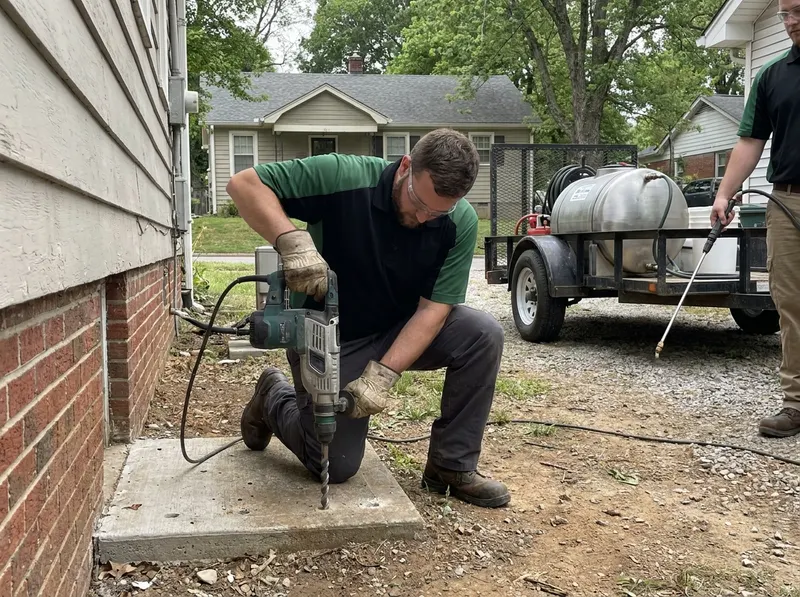
Installation follows a standard five-step clinical engineering procedure. In Step 1, technicians conduct a comprehensive acoustic and physical moisture crawlspace assessment, quantifying wood moisture percentages against the USDA Forest Products Laboratory decay thresholds. In Step 2, our team mechanically trenches soil 6 inches wide by 6 inches deep around exterior foundation perimeters to receive chemical saturation. In Step 3, technicians execute precision sub-slab drilling through masonry expansion joints, spacing injection ports 12 inches apart to treat subterranean access zones beneath garage aprons. In Step 4, low-pressure injection equipment distributes liquid termiticide into subterranean soil, calibrated strictly to manufacturer labels approved by the Tennessee Department of Agriculture regulatory division. In Step 5, technician specialists seal all structural drill voids with non-shrinking hydraulic cement matching existing masonry textures, logging GPS coordinates of exterior bait arrays for ongoing perimeter maintenance.
Every job gets a firm, written price after a free on-site visit.
Tell us about your subterranean termite treatment job in Nashville and we'll send a clear, written quote, usually the same day.
 RavenStone Pest Guard